Three technologies, three different problems
2D machine vision: cameras capture flat images, software analyzes for presence, position, dimension, and pattern matching. Mature technology, widely deployed, well-understood cost structure.
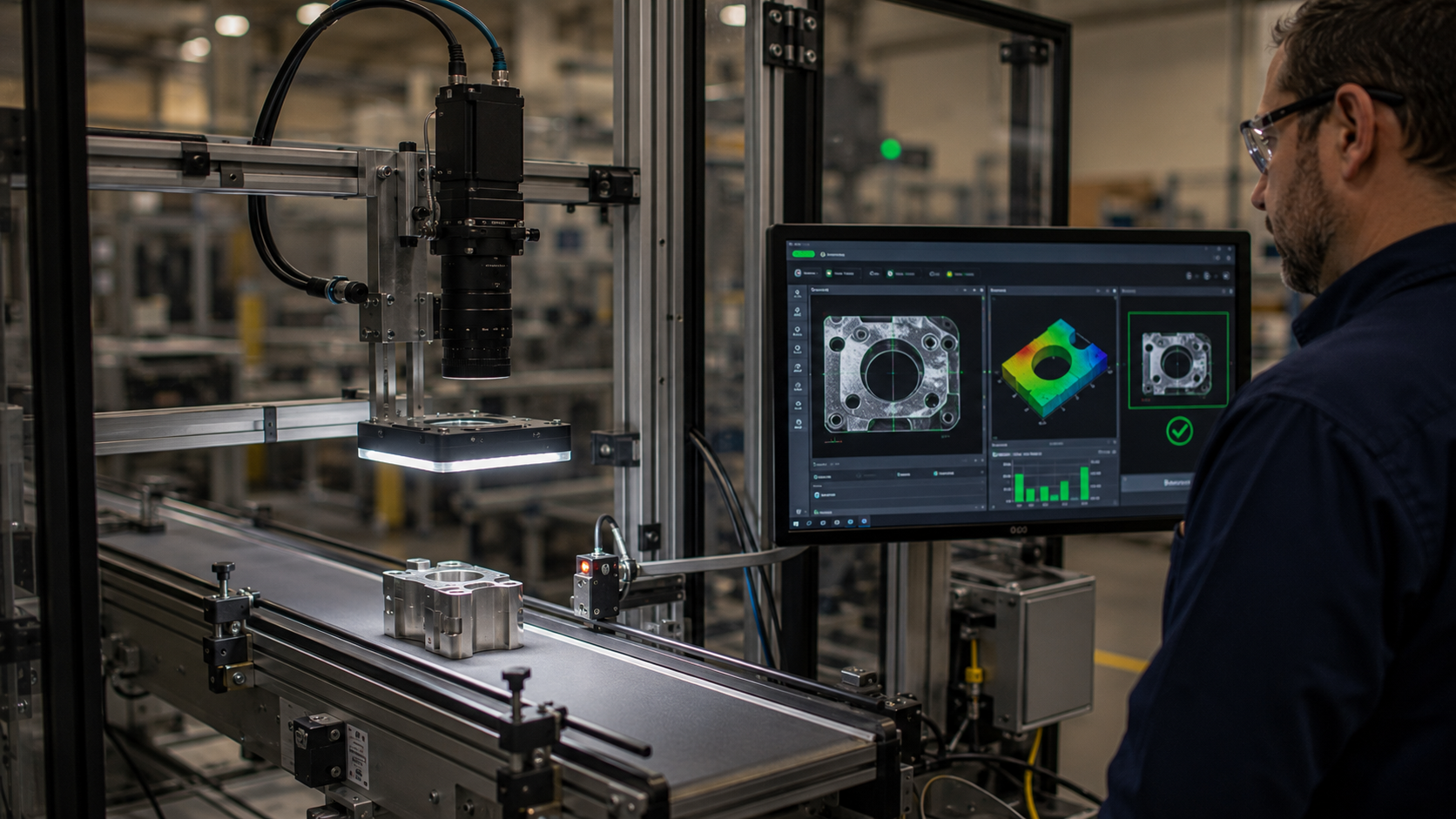
3D machine vision: structured light, laser triangulation, or stereo vision captures depth information. Solves problems 2D can't — dimensional measurement in three axes, surface profile, volumetric inspection.
Deep learning vision: neural network models classify or detect defects that traditional rule-based vision can't reliably describe. Solves problems with high variance where the human eye can identify the defect but a written spec can't define it.
When 2D wins
- Presence/absence detection (part loaded, cap present, label applied)
- Position measurement (part orientation for pick-and-place)
- Dimensional inspection in two axes (width, length, diameter)
- Pattern matching (logo alignment, print quality)
- Barcode and OCR reading
2D vision is the workhorse of industrial inspection. Well-established vendors (Keyence, Cognex, Basler), predictable integration timelines, defined cost structure. If the inspection problem can be solved in 2D, do it in 2D.
When 3D wins
- Height, depth, or volume measurement
- Surface profile inspection (dents, warpage, deformation)
- Bin picking where parts are randomly oriented
- Weld inspection where the fillet geometry matters
- Assembly verification where the presence of a feature at a specific depth is required
3D systems cost 2-4x more than equivalent 2D systems and require more sophisticated integration. But for depth-sensitive inspection, no amount of 2D can substitute.
When deep learning wins
- Defect detection where the defect is visually recognizable but not rule-definable (surface anomalies, color variance, subtle deformation)
- Classification of parts, orientations, or configurations that a rule-based system can't reliably describe
- Applications where the "good" part varies within a range that's hard to specify
Deep learning is not magic. It requires: representative training data (hundreds to thousands of good and bad images), a defined training and validation process, and a plan for how the model gets retrained as the process drifts. Skip any of these and the deployed model will underperform.
Where each technology fails
2D failure modes
- Depth-sensitive defects invisible in flat images
- High variance parts where rules can't capture "good"
- Reflective surfaces or unstable lighting conditions
3D failure modes
- High-speed inspection where 3D capture time exceeds cycle time
- Reflective, transparent, or dark surfaces that scatter or absorb structured light
- Applications where 3D is over-spec for the actual inspection need
Deep learning failure modes
- Small training datasets that don't represent production variance
- Applications where the defect can be rule-defined more cheaply
- Deployments with no model monitoring or retraining plan
The hybrid that gets deployed most often
Modern industrial vision systems increasingly combine technologies: 2D for high-speed positional inspection, 3D for depth-sensitive checks, deep learning for defect classification that traditional vision misses. The integrator's job is to match each technology to the specific inspection task, not to force one technology to do everything.
The DPG view
CSM Robotics and Automation Services Inc. integrate vision systems across all three technologies. If you have an inspection problem and are not sure which technology fits, we can help scope the solution before you commit to a vendor.
.webp)

%20(37).png)