Why most IIoT deployments underdeliver
Industrial IoT gets sold as a strategic transformation. Deployed correctly, it delivers measurable operational improvements. Deployed poorly, it becomes a dashboard nobody looks at and a bill nobody wants to justify.
The difference between the two outcomes is not the technology. It is whether the deployment is tied to a specific decision or process that changes when the data becomes available.
The three IIoT deployments that consistently pay back
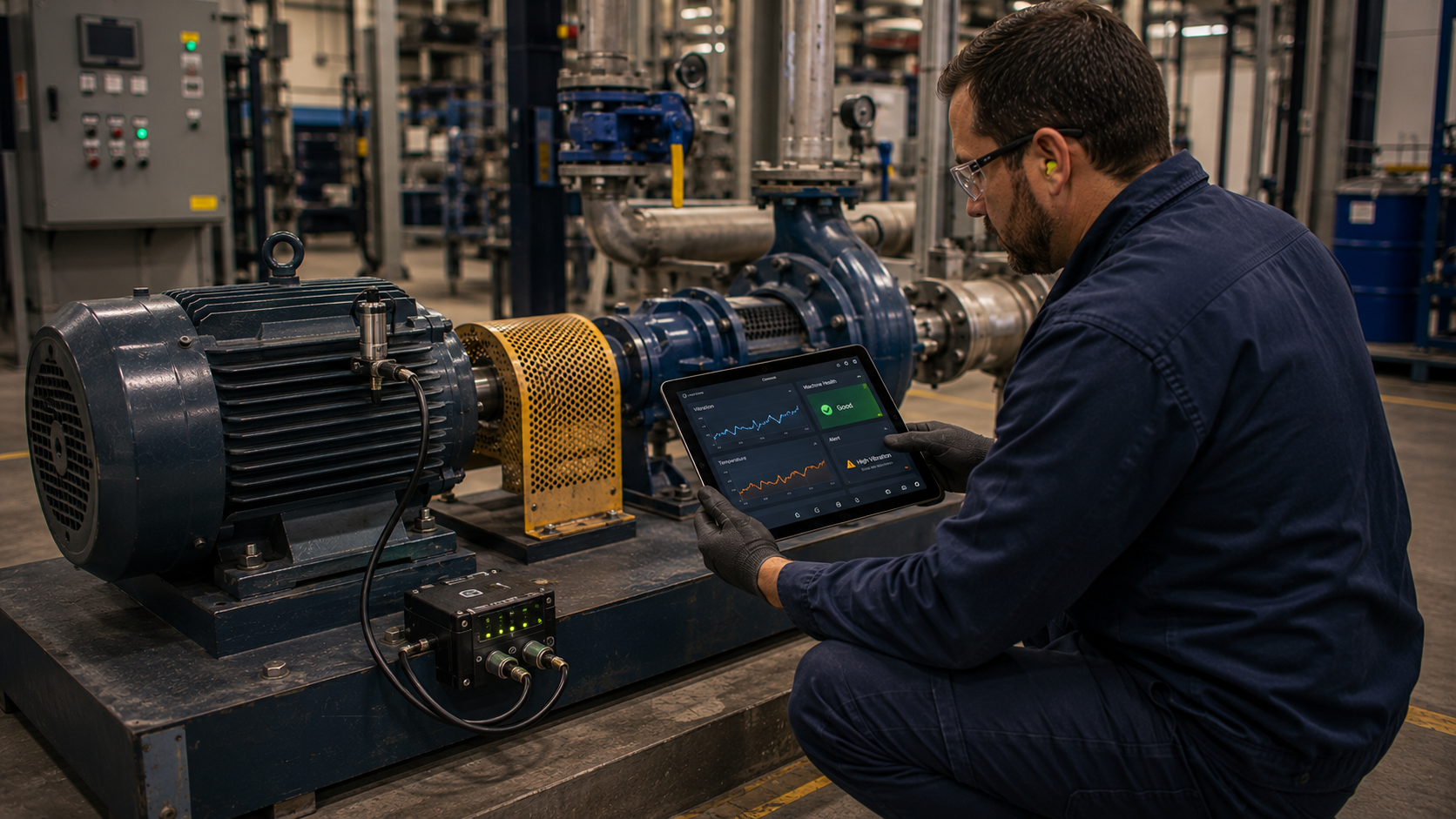
1. Condition-based maintenance on high-value assets
Vibration, temperature, current, and pressure monitoring on assets where unplanned downtime costs more than $10K per hour. The IIoT investment pays back when it catches failures 24-72 hours before they occur, converting unplanned downtime to scheduled maintenance.
Typical payback: 8-18 months for a critical asset.
2. Energy management for high-consumption operations
Real-time energy monitoring on operations where energy is more than 10 percent of unit cost. Identifies waste (equipment running during off-shift, inefficient load profiles, peak demand spikes) that can be operationally corrected.
Typical payback: 12-24 months, depending on how much waste exists.
3. Production tracking for high-mix operations
Real-time WIP tracking, cycle time monitoring, and OEE calculation on high-mix production lines where variance is hard to see without instrumentation. Enables faster response to production disruptions and better utilization visibility.
Typical payback: 12-36 months, depends on how significantly it changes operator behavior.
The IIoT deployments that don't pay back
Universal instrumentation without a decision
Deploying sensors across every asset without a specific decision the data will inform. Data collection cost is real. Data analysis and interpretation cost is real. If nobody acts on the data, it's pure expense.
Dashboards without workflow integration
Beautiful dashboards displayed in the plant manager's office that don't trigger any specific action. If the dashboard is not linked to a maintenance request, an operator alert, or a shift-level decision, it's decorative.
Predictive maintenance on low-value assets
Predictive maintenance investment on assets where unplanned downtime cost is low. If a $50/hour asset fails, running to failure is often cheaper than instrumentation and monitoring cost.
The sequencing that works
- Identify one high-value asset where downtime cost is high and failure modes are somewhat predictable
- Deploy condition-based monitoring on that asset only
- Establish the alert workflow: sensor threshold triggers maintenance ticket, ticket triggers scheduled intervention
- Measure the value: how many unplanned failures were converted to scheduled maintenance in the first 6 months
- Use the proven ROI to justify the second asset deployment
This sequence keeps investment small, ties the investment to a decision, and builds internal proof before scaling. It also builds the organizational muscle to actually use the data.
The technology choices that matter less than people think
- Wireless vs wired sensors (both work; wireless is simpler retrofit, wired more reliable)
- Cloud vs on-prem data platform (both work; cloud is faster to deploy, on-prem gives more control)
- Vendor-specific vs open-standard protocols (both work; open standards give more flexibility long-term)
The technology choices matter less than the organizational commitment to act on the data. Any of the major platforms deployed with clear use cases and workflow integration will deliver value. All of the major platforms deployed without those things will underdeliver.
The DPG view
DP Gayatri and Automation Services Inc. deploy IIoT systems for condition monitoring, energy management, and production tracking across industrial operations. Our default recommendation is to start narrow, prove ROI, then expand. If you are early in an IIoT investment and want a second opinion on scope, that's the conversation we have most weeks.
.webp)

%20(37).png)